
Wired for Controversy: MARL's Path Through the Mountain State

Across the country, there is a growing demand for energy consumption. But one proposed solution to meet that demand, NextEra Energy's MidAtlantic Resiliency Link, is facing mounting opposition from West Virginia county officials and residents. The question remains: Does this project serve their local communities, or does it simply route power to Northern Virginia data centers?
What is the MidAtlantic Resiliency Link?
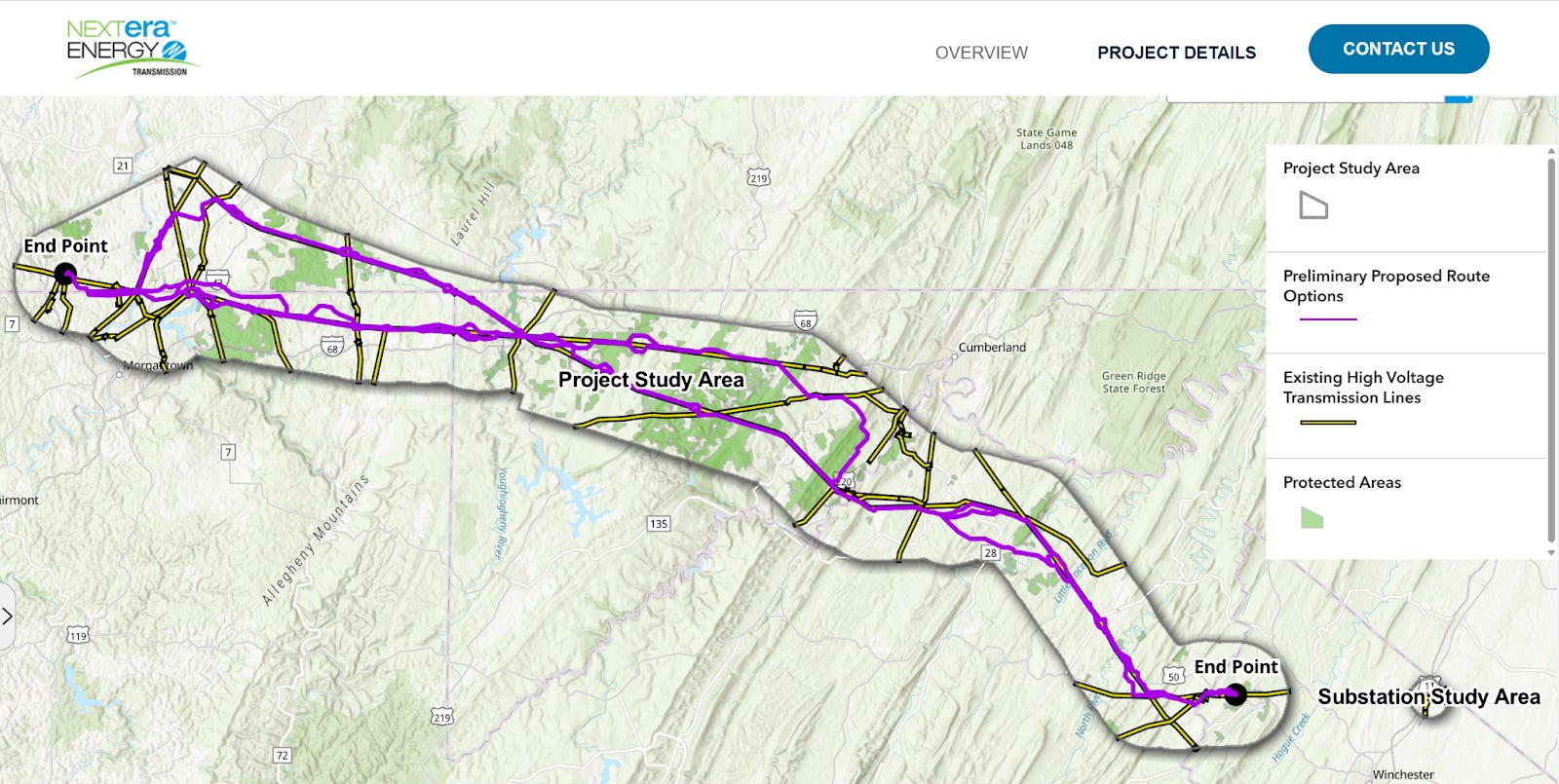
The MidAtlantic Resiliency Link, or MARL, is a 105 mile 500-kV transmission line that will run from Greene County, Pennsylvania to Frederick County, Virginia. According to NextEra Energy, the goal of MARL is to improve grid reliability and support growing energy demands. The new substation in Virginia is part of a broader regional effort by grid operator PJM Interconnection to address power plant retirements and rising electricity needs. While no official route has been selected, proposed routes involve crossings from Pennsylvania into several West Virginia and Maryland counties before ending in Virginia. Still in the planning and development phase, MARL has sparked concerns from local residents and county commissions, especially regarding environmental impacts, land use, and who ultimately benefits from the project.
MARL Timeline
According to the Project Details on NextEra’s website, the anticipated project timeline is as follows:
Fall 2025: State Regulatory Application Filings
Spring 2027: All State Regulatory Approvals Anticipated
Fall 2029: Start of Construction
Fall/Winter 2031: End of Construction followed by Project In-Service
Community Response and Opposition
In April and May of 2025, NextEra held various community forums in the areas that would be impacted by the proposed route of the transmission line. In West Virginia, those occurred at the following dates/locations:
May 5: Slanesville Volunteer Fire Company, Slanesville, WV (Hampshire County)
May 8: Greater Cumberland Regional Airport, Wiley Ford, WV (Mineral County)
May 12: Erickson Alumni Center, Morgantown, WV (Monongalia County)
May 14: Bruceton Brandonville Volunteer Fire Department, Bruceton Mills, WV (Preston County)
Additionally, postcards were sent to property owners whose land fell within the proposed routes and would be impacted.
Community members in the impacted counties have voiced strong concerns about the project’s pathway and lack of energy benefits. Local meetings, including a community-led forum in Preston County on June 29th, 2025, have brought together residents, environmental advocates, and county officials to discuss the implications of MARL.
Across the region, groups such as Stop MARL Virginia have been vocal in criticizing both MARL and Valley Link 765kV transmission line projects. They highlight how the transmission line routes cut through rural and environmentally sensitive areas in West Virginia and Maryland, with the ultimate purpose of serving data centers in Northern Virginia. The group argues that the communities bearing the burden of the transmission line will receive no direct energy benefits, and have called for alternative solutions that do not rely on aging coal-fired power plants or using Appalachian communities to support economic development projects in Northern Virginia.
WV County Commissions Respond to MARL
Three West Virginia County Commissions have passed resolutions opposing MARL from being built within their counties.
Hampshire County was the first to pass a resolution on May 27th, 2025, emphasizing the impact the high voltage lines would have on the local scenery that draws in tourism for the county. There were also concerns about property values and eminent domain seizures that would not directly benefit the state or county.
Preston County passed the resolution opposing MARL on May 28th, 2025. Residents who would be impacted by the project brought forth their concerns to the commissioners. The Commission also consulted with the State Economic Development Authority, which found no local benefits for the project. NextEra estimated that the project would generate $150-400 million in tax revenue, with $50 to $100 million coming to Preston County. However, there was no clear timeline on when these payments would be disbursed.
Mineral County is the latest county to pass a resolution opposing the project, doing so on June 24th, 2025. While the meeting minutes are not posted, their meeting’s recording on YouTube (New Business begins at the 1:10:41 mark) provided a reading of their resolution. The Commission highlighted the strong opposition to the project received from residents, farmers, and landowners about the potential impacts on land values, agricultural operations, tourism, and the scenic integrity of the region. NextEra projected that MARL would generate $75 million in sales and property taxes for Mineral County over the next 40 years. However, this estimate failed to consider the potential loss of property values, long-term depreciation, and an estimated $246 million in infrastructure costs that would be passed on to the ratepayers.
The Monongalia County Commission has heard from residents at multiple commission meetings speaking in opposition to this project, citing concerns about the impact on property values, as well as the controversial crossing of the power line over Cheat Lake. The Commission first met with NextEra in December 2024 to discuss the project. On July 9th, the Commission met again with representatives from NextEra in a work session to have their questions answered. Commission President Jeff Arnett and Commissioner Sean Sikora both expressed that they did not see a benefit to MARL coming through Monongalia County. As of the time this piece was published, the Monongalia County Commission has not passed a resolution opposing MARL.
Take Action: Make Your Voice Heard About MARL!
Contact NextEra Energy
Although the survey period for feedback has passed, you can still subscribe to the newsletter to receive updates about the project, or contact NextEra directly with your questions and concerns about the project.
Email: MARL@nexteraenergy.com
Phone: 833-849-1461
Contact your State Legislators
Even though the Legislative Session has concluded, you can still contact your State Legislators about issues arising in your communities throughout the year. Below is the contact information for our Delegates and Senators for the counties impacted by MARL:
State Senators
Senate 2
Senate 13
Senate 14
Senate 15
House of Delegates
House 77: Joe Statler (R-Monongalia)
House 78: Geno Chiarelli (R-Monongalia)
House 79: Evan Hansen (D-Monongalia)
House 80: John Williams (D-Monongalia)
House 81: Anitra Hamilton (D-Monongalia)
House 82: David McCormick (R-Monongalia)
House 83: George Street (R-Preston)
House 84: D. Rolland Jennings (R-Preston)
House 87: Gary Howell (R-Mineral)
House 88: Rick Hillenbrand (R-Hampshire)
House 89: David Cannon (R-Hampshire)
Contact your County Commissioners
Although most of the counties that will be impacted by MARL have passed resolutions, it is still important to continue contacting your commissioners in voicing your concerns about the transmission line.
Contact the West Virginia Public Service Commission
The PSC is the entity that NextEra will need to receive approval from to begin this project. Voicing your concerns prior to their review is critical in ensuring they hear directly from the public about the impacts this project could have on West Virginians.
This piece was authored by Cal Carlson.
Thanks for capturing the issue and status of reviews in different counties